
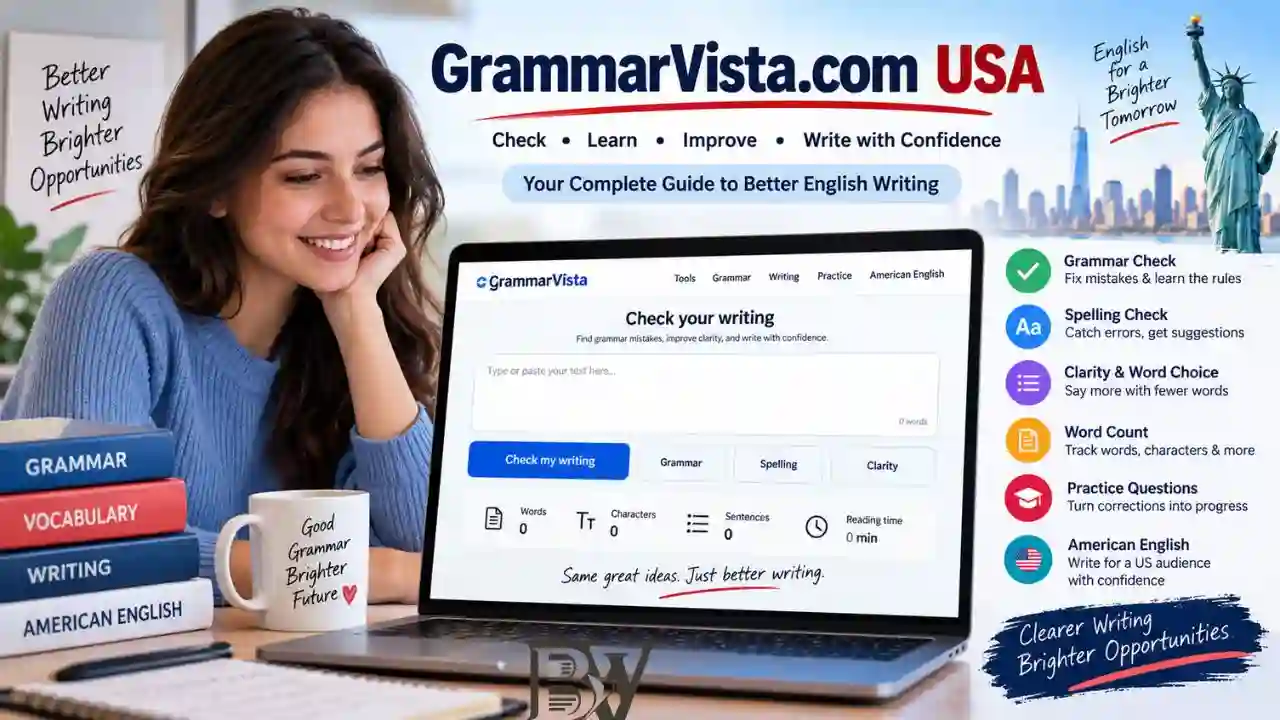
GrammarVista.com USA: A Complete Guide to Grammar, Writing, and American English
GrammarVista.com USA refers to GrammarVista.com and its focus on American English grammar, spelling, vocabulary, and practical writing support. The website combines grammar explanations with browser-based writing tools designed to help users understand not only what needs changing in a sentence, but also why the change is necessary. GrammarVista says its core checker is free, requires no account, and runs in the browser.
For US students, professionals, job seekers, writers, content creators, educators, and English learners, GrammarVista.com can serve as a quick writing check and a way to learn recurring grammar and usage rules.
What Is GrammarVista.com USA?
GrammarVista.com USA is best understood as an online English-learning and writing resource rather than a separate US-only website. The current site offers grammar, spelling, clarity, word choice, vocabulary, readability, practice, and word-count resources, along with a dedicated guide to American English.
The platform takes an educational approach to correction. Its main checker shows a suggested fix, alternative options where available, and the rule or reason behind the change rather than simply marking a word as wrong.
That distinction matters because effective writing improvement involves more than fixing one sentence. Understanding the reason for a correction makes it easier to recognize the same pattern the next time you write.
How GrammarVista.com USA Helps With American English
American English has several spelling, vocabulary, punctuation, and usage conventions that differ from British English.
GrammarVista.com says American English is the default variety across the site, while its resources also explain British English differences rather than treating one variety as universally “correct.”
Some familiar examples include:
| Writing area | American English | British English |
|---|---|---|
| -or / -our | color | colour |
| -er / -re | center | centre |
| Single or double “l” | traveled | travelled |
| Everyday transport | truck | lorry |
| Vacation terminology | vacation | holiday |
| Weekend expression | on the weekend | at the weekend |
| Date format | August 25, 2026 | August 25 2026 |
One useful nuance is that -ize is not exclusively American. GrammarVista points out that Oxford style also uses forms such as “organize” in British English, so “organize” versus “organize” is not as simple a US-versus-UK rule as “color” versus “color.”
GrammarVista.com USA Grammar Checker
GrammarVista’s main writing checker covers 134 grammar and usage rule groups, according to the site’s current tools page. These include subject-verb agreement, verb forms after helper words, countable and uncountable nouns, comparatives, certain prepositions, and commonly confused words.
The checker is designed to show more than a corrected sentence. GrammarVista says users can see the fix, alternatives, and the reason behind the change.
For example, someone writing:
“She don’t like coffee.”
needs a subject-verb agreement correction:
“She doesn’t like coffee.”
The useful part for a learner isn’t just seeing “doesn’t.” It is understanding that the third-person singular subject takes doesn’t, not don’t, in standard English.
What the Grammar Checker Can Help Identify
GrammarVista says its grammar checker covers areas including:
- Subject-verb agreement
- Verb forms after helper verbs such as will, did, and to
- Countable and uncountable nouns
- Comparatives
- Prepositions that commonly go with particular verbs
- Confusable word pairs such as your and you’re
- Other grammar and usage patterns
The site does not claim that its checker can identify every possible problem. It explicitly notes that a clean result does not guarantee perfect writing.
How to Use GrammarVista.com USA: A Hands-On Walkthrough
The easiest way to understand GrammarVista is to use it on a real paragraph rather than simply reading about its features.
Here is a practical workflow a first-time user can follow.
Step 1: Open GrammarVista.com
Start on the GrammarVista homepage and find the main writing checker.
The current interface presents a text area labeled “Your text”, a “Check my writing” action, and buttons that let you focus on Grammar, Spelling, Clarity, or use the broader check. The page also shows live counts for words, characters, sentences, and estimated reading time.
You don’t need to create an account to check text. GrammarVista currently advertises the core tools as free and available without sign-up.
What to do
Take a short paragraph you actually wrote.
For example:
The team of students are preparing there final presentation. They was very worried about the deadline, but they worked hard and completed everything on time.
Paste it into the checker.
This is more useful than testing an already-perfect sentence because the goal is to see how the tool handles several different problems.
Step 2: Start With a Grammar Check
Once the text is in the box, run the grammar check or use the full check.
GrammarVista identifies grammar and usage issues and explains the correction. Its homepage says a finding can include the fix, alternative options, and the reason for the change.
For the sample paragraph, you would want to review issues such as:
“The team of students is…”
The key question is: what is the subject of the sentence?
The subject is team, not students.
So the corrected sentence is:
“The team of students is preparing…”
That same subject-verb principle is illustrated in GrammarVista’s own grammar lessons: extra words between the subject and verb can make the wrong noun appear to be the subject.
Don’t just accept the correction.
Before moving on, ask yourself:
What rule caused the change?
That small habit turns a grammar checker from a proofreading shortcut into a learning tool.
Step 3: Compare the Suggested Options
One of GrammarVista’s useful features is that a correction can include up to three possible fixes, where alternatives make sense.
This matters because automated writing suggestions aren’t always a simple case of one word being universally correct.
Suppose the tool highlights a phrase and offers several replacements.
Instead of clicking the first suggestion automatically, consider:
- Which option preserves my intended meaning?
- Which one matches my tone?
- Which one sounds natural for my audience?
- Is the suggestion actually necessary?
The goal is not to make the software write your entire sentence for you.
The goal is to use its suggestions intelligently.
Step 4: Read the Explanation Behind the Fix
This is the step many users skip.
GrammarVista is built around the idea that a correction should include the rule behind it. Its editorial policy also says lessons should answer the question first, include exceptions, and provide practical tests where a reliable mental test exists.
For example, if the checker identifies a subject-verb agreement problem, don’t stop at:
Wrong → Right
Instead, understand the underlying pattern.
GrammarVista’s grammar guide gives a useful mental test for sentences such as:
The box of pens are on the table.
Cover the extra phrase “of pens.”
You are left with:
The box is on the table.
That makes the real subject much easier to see.
A practical learning rule
After every correction, try to explain the correction out loud in one sentence.
For example:
“I used are because I focused on students, but the actual subject is team, so it should be is.”
If you can explain the correction yourself, you are far more likely to remember it.
Step 5: Run a Spelling Check
After reviewing grammar, check spelling separately or use the broader check.
GrammarVista says its spelling checker compares words against a dictionary containing 276,734 English words. When it doesn’t find a word, the tool can suggest up to three close alternatives. It also tries not to flag unfamiliar terms automatically when there is no convincing match, since that may indicate a name or technical term rather than a spelling mistake.
Example
Imagine you type:
The meeting was definately moved to Friday.
A spelling check should direct your attention to:
definitely
The important part is still the human decision. If you see a strange technical term, brand name, surname, or specialist word, don’t replace it just because software does not recognize it.
Step 6: Check Clarity and Word Choice
Once grammar and spelling are clean, look at clarity.
GrammarVista says its clarity and word-choice tool flags wordy phrases and weak adjectives, including phrases built around “very”, and offers stronger alternatives.
Consider this sentence:
We are currently in the process of reviewing the document at this point in time.
It is understandable, but several words add little value.
A tighter version might be:
We are reviewing the document.
That is a good reminder that grammatically correct does not automatically mean clear.
GrammarVista’s writing guidance makes the same distinction: a checker can fix mechanical issues, but decisions about argument, structure, responsibility, and tone still require human judgment.
Step 7: Check Your American English Consistency
This step is particularly relevant when the audience is in the United States.
GrammarVista’s checker uses American English by default, while the site also explains British equivalents.
Before publishing, scan your document for consistency.
For a US audience, examples include:
| Use consistently in US-focused writing | UK equivalent |
|---|---|
| color | colour |
| center | centre |
| traveled | travelled |
| apartment | flat |
| elevator | lift |
| vacation | holiday |
| sidewalk | pavement |
Do not change perfectly valid British English just because your audience includes Americans. The key is to choose the appropriate variety for the project and use it consistently. GrammarVista explicitly treats American and British English as standard varieties rather than declaring one superior.
Step 8: Check the Word Count
Once the writing is polished, use the built-in word counter to review the length.
GrammarVista says its counter updates live and can display:
- Words
- Characters
- Sentences
- Estimated reading time
This is particularly handy for:
- School assignments
- Application essays
- Blog posts
- Social content
- Emails
- Short business reports
- Writing exercises
Instead of repeatedly copying your text into a separate word-count website, you can see these measurements while editing.
Step 9: Use the Practice Section to Make Corrections Stick
GrammarVista also includes grammar practice questions.
The current practice guidance recommends explaining why an answer is correct before clicking it, returning after a few days rather than repeating the same questions immediately, and applying missed rules to your own writing.
That creates a much better learning loop:
Find a mistake → understand the rule → practice the rule → find the same pattern in your own writing.
For example, suppose the checker repeatedly catches subject-verb agreement mistakes.
Don’t simply fix ten sentences and forget them.
Take your next email or essay and deliberately look for sentences where extra words appear between the subject and the verb.
That is where an online checker becomes a genuine learning aid.
A Realistic 10-Minute GrammarVista Editing Routine
For someone who wants a simple, repeatable process, this is a practical routine:
Minute 1–2: Paste the draft
Put your paragraph, email, assignment, or article section into the checker.
Minute 3–4: Fix grammar
Review each grammar alert and read the explanation before accepting the change.
Minute 5–6: Check spelling
Look for misspellings, but manually review unfamiliar names, brands, specialist terminology, and technical vocabulary.
Minute 7–8: Improve clarity
Look at wordy phrases and unnecessary adjectives. Keep suggestions that make the sentence clearer without changing your intended meaning.
Minute 9: Check American English consistency
Review US-versus-UK spelling and vocabulary if the content is intended for an American audience.
Minute 10: Read it yourself
Read the revised passage aloud or slowly from beginning to end.
This final human pass matters because the checker cannot decide whether your argument is persuasive, whether the paragraph belongs where it is, or whether your tone fits your reader. GrammarVista itself makes that limitation clear.
A Before-and-After Example
Here is what a complete editing session might look like.
Original
The team of students are preparing there final presentation. They was very worried about the deadline, but they worked very hard in order to complete everything on time.
Grammar pass
Correct:
The team of students is preparing their final presentation. They were very worried about the deadline, but they worked hard to complete everything on time.
What changed?
are → is
The subject is team, which is singular in this American English construction.
there → their
The sentence requires the possessive form.
was → were
The subject they takes were.
very hard to complete → hard to complete
The longer phrase can be simplified without losing meaning.
Final version
The team of students is preparing their final presentation. They were very worried about the deadline, but they worked hard to complete everything on time.
This example shows why the strongest workflow is not simply “paste, click, copy.”
It is:
paste → inspect → understand → revise → reread.
Grammar, Spelling, and Clarity Tools
Grammar is only one part of effective writing. GrammarVista currently presents several browser-based tools, including grammar checking, spelling checking, clarity and word choice, word counting, readability, and a word explorer.
Spelling Checker
The spelling tool checks words against the site’s large English dictionary and provides alternatives when it finds a likely misspelling.
Clarity and Word Choice
The clarity tool flags wordy phrasing and weak adjectives and suggests more direct alternatives.
Word Counter
The live counter displays words, characters, sentences, and estimated reading time as the user types.
Practice Questions
The practice section turns common grammar mistakes into short exercises and provides feedback after each answer.
Is GrammarVista.com USA Free?
Yes. GrammarVista currently states that its main tools are free, require no account, and have no daily usage cap or paid tier withholding better corrections.
That makes it practical for users who want an occasional check without signing up for another software service.
Because websites can change, users should still review the current site and terms for the latest service details.
Does GrammarVista.com Store Your Writing?
GrammarVista says its core checker runs in the user’s browser and that the text entered into the grammar checker is not uploaded, stored, or logged. The site’s privacy policy says the checker and dictionary download to the browser and that the text isn’t sent to the server while the user types.
The site also notes one important distinction: its word explorer can send the individual word being looked up to an external dictionary service. It does not send the user’s full text for that lookup.
For confidential or sensitive material, users should still review the current privacy policy before using any third-party service.
Who Can Benefit From GrammarVista.com USA?
Students
Students can use GrammarVista for essays, assignments, applications, and general academic writing while learning the rules behind recurring mistakes.
Professionals
Professionals can use it to review emails, reports, presentations, proposals, and other business writing before sending or publishing.
Job Seekers
Grammar checks can help identify mechanical errors in resumes, cover letters, application answers, and professional profiles.
Content Creators and Bloggers
Writers producing US-focused content can use the American English guidance to maintain consistent spelling and vocabulary.
English Learners
English learners may get particular value from the explanations and practice exercises because they reinforce the reason behind each correction.
Why American English Consistency Matters
Choosing American or British English is not primarily about deciding which variety is “correct.”
Both varieties are established forms of English. The more important issue is consistency.
A website that switches between “color” and “color,” or between US and UK vocabulary, may look less polished even when every individual word is valid.
GrammarVista’s American English guide recommends choosing the appropriate variety and staying consistent throughout a piece of writing.
What GrammarVista.com USA Cannot Replace
An automated checker is most useful for mechanical and usage-level problems.
It cannot reliably determine whether:
- Your argument is convincing
- Your research is accurate
- Your paragraph is in the right place
- Your tone suits the audience
- Your information is complete
- Your overall structure works
- A stylistic choice is appropriate for the situation
GrammarVista itself says it does not replace a teacher or editor and does not claim an accuracy percentage for its checker. Instead, its editorial policy identifies the categories the tools actually cover.
That distinction matters for anyone using online writing software seriously.
A Practical Way to Use GrammarVista.com USA
The strongest workflow is to treat GrammarVista as one part of the editing process.
Step 1: Write the first draft
Get the ideas down without stopping over every punctuation mark.
Step 2: Run a grammar check
Identify mechanical errors and read the explanation behind each correction.
Step 3: Check spelling
Review likely misspellings while manually validating unfamiliar names and specialist vocabulary.
Step 4: Improve clarity
Cut unnecessary words where doing so makes the sentence cleaner without changing the meaning.
Step 5: Check regional consistency
For US-facing content, confirm you use American spelling and vocabulary consistently.
Step 6: Practice recurring mistakes
Use GrammarVista’s practice exercises for errors you keep making, then look for those same patterns in your own writing.
Step 7: Perform a human edit
Read the entire piece for meaning, structure, tone, factual accuracy, and flow.
Frequently Asked Questions About GrammarVista.com USA
Is GrammarVista.com USA a separate website?
The current site presents GrammarVista.com USA as its American English guide and positioning, while the main service operates through GrammarVista.com.
Does GrammarVista.com use American English?
Yes. GrammarVista says its checker defaults to American English, while its dictionary supports both American and British spelling.
Is GrammarVista.com free?
Yes. The current website says its tools are free, don’t require an account, and don’t impose a daily cap.
Can GrammarVista check spelling?
Yes. Its spelling checker uses a dictionary listed as containing 276,734 words.
Does GrammarVista improve writing style?
It can help with clarity and word choice by identifying wordy phrases and weak adjective constructions. It cannot independently judge the quality of an argument, the overall organization of an article, or whether a particular tone fits a specific reader.
Is GrammarVista suitable for students?
Yes. Its explanations and practice questions are especially useful for learners who want to understand recurring grammar mistakes rather than remove them.
Can it replace an English teacher?
No. Grammar checking can provide useful mechanical feedback, but teachers and editors provide broader judgment, instruction, context, and feedback.
Does GrammarVista support British English?
Yes. The site discusses both varieties and says its dictionary contains both. Where usage genuinely differs, the site labels the alternatives rather than presenting one variety as universally correct.
Can I use GrammarVista on my phone?
The current homepage describes the site as mobile-friendly and fully responsive, making it suitable for checking writing from mobile browsers as well as larger screens.
Final Thoughts on GrammarVista.com USA
GrammarVista.com USA is useful for readers searching for a practical American English grammar and writing resource. Its strongest feature isn’t just correction; it is the combination of correction, explanation, alternatives, and practice.
For those results, don’t treat the checker as an automatic “fix everything” button.
Instead, paste in a real piece of writing, examine each correction, understand the rule, check spelling and clarity, confirm your American English choices, and then read the finished version yourself.
That workflow helps you produce cleaner writing today while gradually becoming a stronger writer without relying on the tool for every sentence.