
FintechZoom.io Stock Market Course: What It Covers, Who It’s For, and What to Verify Before Enrolling
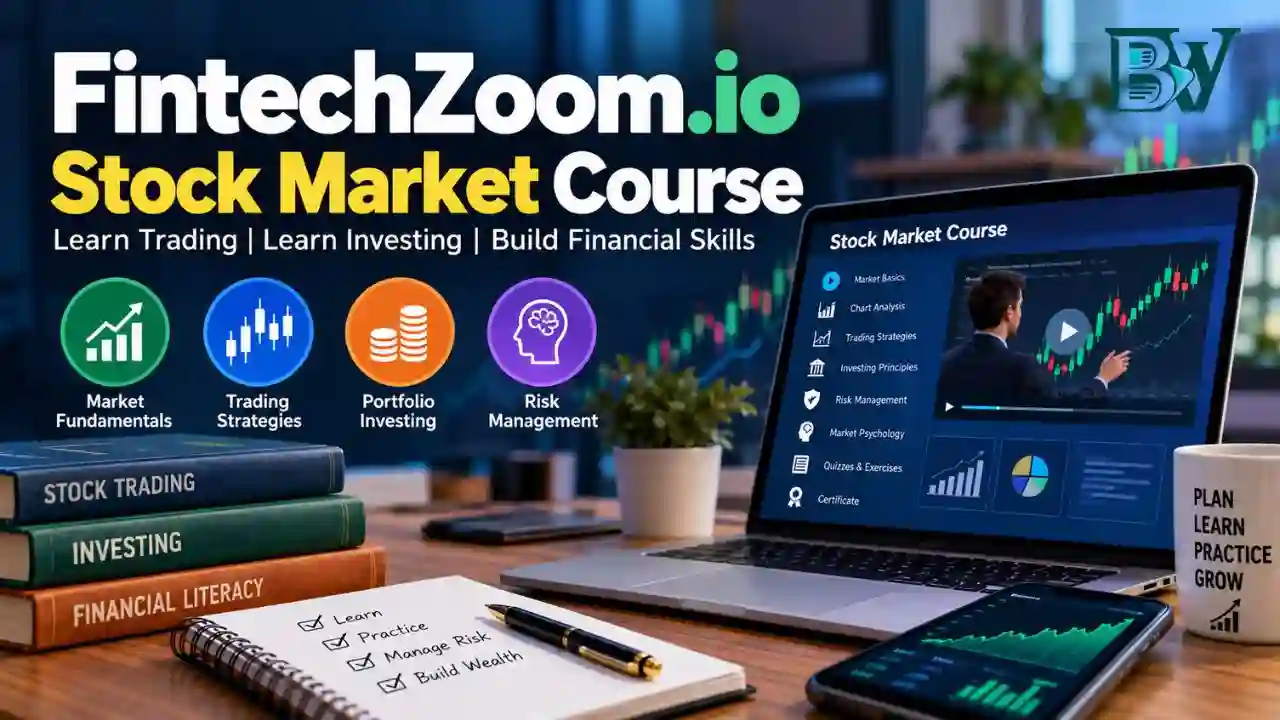
The fintechzoom.io stock market course refers to stock-market education available through FintechZoom.io, which currently presents separate learning options for Stock Market Trading and Stock Market Investing, along with a broader Financial Literacy course. The trading program focuses on market fundamentals, chart patterns, trading styles, risk control, market psychology, indicators, and related tools, while the investing program focuses more on asset classes, portfolio construction, diversification, valuation, and long-term investing.
Prospective students should also understand an important verification issue before paying for any course. FintechZoom.com has publicly stated that fintechzoom.io is not affiliated with its official domain. Because of that distinction, readers should verify exactly who operates the course and what organization stands behind the educational material before enrolling.
That means a useful review needs to do more than repeat marketing language. It should explain what the .io website actually offers, distinguish provider claims from independently verified information, and show readers what to check before enrolling.
What Is the FintechZoom.io Stock Market Course?
The phrase fintechzoom.io stock market course can be slightly misleading because FintechZoom.io does not currently present its stock education as one single course.
Its Courses section lists three main areas:
| Course | Main Focus | Listed Format |
|---|---|---|
| Financial Literacy | Budgeting, saving, debt, investing and personal finance | Self-paced |
| Stock Market Trading | Trading strategies, chart analysis, risk management and market tools | 4–6 hours of video lessons |
| Stock Market Investing | Investing principles, portfolio construction, diversification and long-term strategies | 7–8 hours of video lessons |
FintechZoom.io describes its courses as suitable for beginners as well as people with existing knowledge. It also presents self-paced learning, interactive exercises, support, practical resources and continued access to course materials.
The distinction between trading and investing matters. Trading generally involves making decisions around shorter-term price movements and market opportunities, while investing commonly focuses on building and managing assets over longer periods.
Understanding which of those approaches you actually want to learn can make the course information much easier to evaluate.
What Does the FintechZoom.io Trading Course Teach?
The Stock Market Trading program is presented as a broad introduction to market participation, technical analysis and trading strategy.
According to the published course description, learners are introduced to different types of markets, candlestick patterns, trends, price movements, day trading, swing trading and position trading. It also discusses stop-loss strategies, portfolio allocation, emotional discipline, market indicators and trading psychology.
The curriculum also covers stock, options and forex markets, margin trading, algorithmic trading, trading applications and software, news and global events, and techniques for interpreting market movements.
For someone starting from scratch, that creates a fairly broad learning path rather than concentrating only on stock-picking.
Core Trading Topics Listed by FintechZoom.io
The course focuses on areas such as:
- Market fundamentals and market participation
- Candlestick patterns
- Price trends and movements
- Day trading
- Swing trading
- Position trading
- Stop-loss strategies
- Portfolio allocation
- Trading psychology
- Market indicators
- Trading platforms and software
- Options and forex
- Margin trading
- Algorithmic trading
- News-driven market movements
The trading course is described as containing several hours of on-demand video lessons, downloadable charts and strategy guides, interactive quizzes and a completion certificate.
These features are presented by the course provider, so prospective students should verify what is included before purchase.
How Does the Stock Market Investing Course Differ?
The second stock-focused option is the FintechZoom Investment Mastery Course.
Instead of concentrating primarily on active trading, this program is described around building an investment strategy and managing a portfolio. It covers equities, bonds, mutual funds, ETFs, real estate and alternative investments, as well as asset allocation, diversification and different investing approaches.
The published syllabus also includes topics such as:
- Value investing
- Dividend-growth investing
- Passive index strategies
- Portfolio allocation
- Rebalancing
- Hedging
- Economic indicators
- International markets
- ESG investing
- Tax considerations
- Investment tools and applications
- Behavioral biases
- Options and futures
- Artificial intelligence and robo-advisors
- Wealth preservation
- Investing during economic downturns and market crises
The investing course is described as containing several hours of on-demand lessons, worksheets, interactive quizzes and a certificate.
A completion certificate should not automatically be interpreted as a professional financial qualification, license or academically accredited credential.
Who Can Take the FintechZoom.io Courses?
FintechZoom.io states that no prior experience is required for its courses.
The broader fintechzoom.io courses offering is positioned for beginners while also containing material for people who already have some financial or market knowledge.
The individual stock-market programs also identify different types of learners, including new traders, intermediate traders, beginner investors, intermediate investors and working professionals.
That makes the platform potentially relevant to several types of learners. However, being designed for beginners does not mean every strategy is suitable for every beginner.
Someone who is completely new to finance may benefit from learning the basics of budgeting, emergency savings, risk and diversification before moving into advanced trading strategies.
What Are the Main Features of FintechZoom.io Courses?
The general course offering presents several features designed to make online learning easier.
One is self-paced study, allowing students to progress according to their own schedule. The platform also describes continued access to learning materials and updates.
Other listed features include practical exercises, quizzes, support and community access.
| Feature | What It Means for Learners |
|---|---|
| Self-paced study | Students can learn according to their own schedule |
| Course access | Materials can be revisited after lessons |
| Practical learning | Examples and exercises support the lessons |
| Quizzes | Help reinforce concepts |
| Support | Learners can seek help when needed |
| Community | Students may interact with other learners |
| Updates | Course material may receive updates |
| Certification | Completion certificates are available for listed courses |
These are provider-stated features. Before making a purchase, learners should confirm exactly what access, support and certification include.
For example, a certificate of completion is not necessarily equivalent to a regulated financial qualification.
What Should Beginners Learn Before Trading Real Money?
A stock market course can introduce concepts, but education does not remove investment risk.
Before putting real money into the market, a beginner should understand risk tolerance, risk capacity and investment time horizon.
Risk tolerance concerns how comfortable someone is with potential losses. Risk capacity is about how much loss a person can realistically afford. Time horizon refers to how long the money can remain invested before it may be needed.
These factors can produce very different financial decisions.
Someone investing for a long-term goal may approach the market differently from someone trying to trade frequently. Likewise, someone without an emergency fund may have very different financial priorities from someone with sufficient cash reserves.
That is why stock-market education should come before attempting sophisticated approaches involving margin, leverage or derivatives.
Why Risk Management Matters in a Stock Market Course
Risk management is one of the most important areas to understand because successful market participation is not simply about finding opportunities.
The FintechZoom.io trading curriculum specifically highlights stop-loss strategies, portfolio allocation and emotional discipline.
A practical learner should go beyond memorizing financial terminology.
Before entering a hypothetical trade, consider writing down:
- Why the trade is being considered.
- How much could potentially be lost.
- What would prove the original idea wrong.
- How much capital is being exposed.
- What would cause you to stop trading for the day.
This process can help separate planned decisions from emotional reactions.
Trading Psychology Is More Than a Course Topic
The trading program includes trading psychology and emotional discipline among its educational areas.
That matters because market decisions can be affected by fear, greed, overconfidence, frustration and the temptation to chase recent price movements.
One practical technique is maintaining a trading or investment journal.
After each simulated or real position, record what you expected, what actually happened, whether you followed your rules and whether the result came from a sound process or simply favorable market movement.
Over time, a journal can reveal patterns in decision-making that may not be visible from price charts alone.
Does FintechZoom.io Have a Certificate?
Yes. The individual stock-market course descriptions state that students can receive a certificate of completion.
However, prospective students should investigate what that certificate actually represents before treating it as a professional credential.
Useful questions include:
- Who issues the certificate?
- Is there an examination?
- Is there an identifiable instructor?
- Is the credential accredited or recognized by a professional organization?
- Does it demonstrate course completion only, or independently assessed competency?
These questions become especially important when a certificate is intended for employment, university applications or regulated financial work.
How Much Does the FintechZoom.io Stock Market Course Cost?
Pricing should be checked directly before enrollment.
The published course descriptions focus primarily on curriculum, format, features and enrollment information rather than providing enough context to independently evaluate whether the cost represents good value.
Readers should therefore verify:
- Total course price
- Payment method
- Refund policy
- Access period
- Additional fees
- Whether future renewals apply
- What materials are included
The site also presents a satisfaction guarantee. However, prospective students should read the full conditions to understand eligibility requirements and refund procedures.
The Most Important Verification Issue: FintechZoom.io vs. FintechZoom.com
This is one of the most important points for prospective students.
FintechZoom.com has publicly stated that its official domain is FintechZoom.com and that fintechzoom.io is not affiliated with it.
At the same time, fintechzoom.io operates its own financial website and publishes its own course-related material.
The practical lesson is simple:
A course published on fintechzoom.io should not automatically be described as an official FintechZoom.com course.
Readers should distinguish the claims made by fintechzoom.io from statements made by the separate FintechZoom.com organization.
For a financial education product, confirming the identity of the provider is especially important before entering payment information or sensitive personal details.
How to Verify a Course Before Paying
Before purchasing a course, take a few minutes to confirm the basic details.
Check the Domain Carefully
Double-check the website address before creating an account or making a payment.
Brand names can appear across similar-looking domains, so the exact web address matters.
Ask Who Teaches the Course
A credible financial education program should provide enough information for prospective students to understand who is responsible for the educational content.
Look for identifiable instructors, professional backgrounds, relevant qualifications and verifiable experience.
Statements such as “industry experts” are less useful when no instructor names or credentials are provided.
Request a Full Syllabus
The public descriptions provide many topic categories, but prospective learners can still ask for a complete module-by-module syllabus.
A useful syllabus should show:
- What each module teaches
- Learning objectives
- Practical exercises
- Assessment methods
- Expected outcomes
Read the Refund Terms
Do not rely only on a headline such as “money-back guarantee.”
Read the detailed policy to understand the exact requirements for receiving a refund.
Avoid Promises of Guaranteed Trading Profits
No legitimate educational program can remove market uncertainty.
A course can teach concepts, analytical frameworks and strategies. It cannot guarantee a specific trading or investing return.
FintechZoom.io Stock Market Course vs. Free Learning
Paid courses are not automatically better than free resources, and free resources are not automatically better than paid courses.
The useful question is whether the paid program provides meaningful value that is difficult to reproduce independently.
A structured course may save time by organizing material into a logical sequence. Free resources can offer a wider variety of opinions and explanations.
| Factor | Paid Course | Free Resources |
|---|---|---|
| Structure | Usually organized | Often fragmented |
| Cost | Requires payment | Usually free |
| Support | May include provider support | Depends on platform |
| Curriculum | Selected by provider | Learner chooses topics |
| Flexibility | Depends on access model | Usually highly flexible |
| Quality control | Varies by provider | Varies widely |
| Certificate | May be available | Usually unavailable |
The important issue is not whether learning materials are paid or free. The important issue is whether they are accurate, transparent, useful and suitable for the learner’s goals.
A Practical Way to Use a Stock Market Course
Simply watching several hours of financial videos does not automatically create market expertise.
A better approach is to combine lessons with structured practice.
Start by learning the basics of stocks, ETFs, indexes, orders, volatility, diversification and investment risk. Then move into chart interpretation and financial analysis before exploring advanced strategies.
For active trading concepts, paper trading or a simulator can provide a way to practice without putting real money at risk.
For investing, learners can practice evaluating companies or funds using publicly available information. Writing down the reasoning before seeing the eventual result can help build analytical discipline.
It is also important to separate decision quality from outcome quality. A profitable trade does not automatically mean the strategy was sound, while a losing trade does not automatically mean the decision was wrong.
Pros and Limitations to Consider
The FintechZoom.io stock-market offering covers a broad range of educational subjects.
The trading material includes different trading styles, technical analysis, market indicators, risk management, trading psychology and market-related tools. The investing material covers diversification, portfolio construction, multiple asset classes and long-term investment approaches.
The breadth of the curriculum may be useful for beginners who want to understand how different areas of financial markets connect.
There are also limitations.
The publicly available course descriptions do not provide enough independent information to evaluate instructor quality, student outcomes or the long-term effectiveness of the strategies taught.
The separate identity issue involving fintechzoom.io and FintechZoom.com is another factor that prospective students should investigate before making a payment.
Is the FintechZoom.io Stock Market Course Suitable for Beginners?
The website explicitly presents its stock-market courses as suitable for beginners and says previous experience is not required.
For a beginner, the structured coverage of market concepts, charts, investing styles, diversification, risk management and trading psychology may provide a useful starting framework.
However, beginners should not interpret a course as a reason to rush into real-money trading.
The strongest use of an introductory program is to develop enough knowledge to understand how markets work, recognize financial risks and identify which subjects still require additional study.
Frequently Asked Questions
Is FintechZoom.io the Same as FintechZoom.com?
No assumption should be made that the two domains represent the same organization. FintechZoom.com has publicly stated that it is the official domain and that fintechzoom.io is not affiliated with it.
Fintechzoom.io, meanwhile, operates its own website and publishes its own financial and educational content.
What Courses Does FintechZoom.io Offer?
The current course offering includes Financial Literacy, Stock Market Trading and Stock Market Investing.
The stock-market programs are presented as separate trading and investing paths rather than one universal stock-market course.
How Long Is the FintechZoom.io Stock Market Trading Course?
The Stock Market Trading course is described as containing approximately 4–6 hours of on-demand video lessons, alongside charts, strategy resources and quizzes.
Does the FintechZoom.io Investing Course Include a Certificate?
Yes. The investing course description states that learners receive a certificate after completing the program.
However, students should verify what the certificate represents and whether it has any independent accreditation or professional recognition.
Can a Stock Market Course Guarantee Profits?
No educational course should be treated as a guarantee of trading or investment profits.
Markets remain uncertain, and returns can vary depending on asset prices, economic conditions, strategy, timing and risk exposure.
Final Thoughts on the FintechZoom.io Stock Market Course
The fintechzoom.io stock market course search term points to a collection of financial education programs rather than one narrowly defined class.
The website presents separate Stock Market Trading and Stock Market Investing programs covering topics that range from candlestick patterns and trading psychology to diversification, portfolio construction and long-term investment strategies.
For people researching fintechzoom.io courses, the most important step is to look beyond the promotional description.
Verify who operates the course, who teaches the material, what the certificate represents, how much the program costs, what the refund terms say and what evidence exists regarding the educational quality.
The distinction between fintechzoom.io and FintechZoom.com should also be confirmed carefully before enrollment.
A stock-market course can provide useful knowledge and structure, but it cannot eliminate market risk or guarantee financial success. The best use of financial education is to become better at understanding uncertainty, evaluating information and making informed decisions.